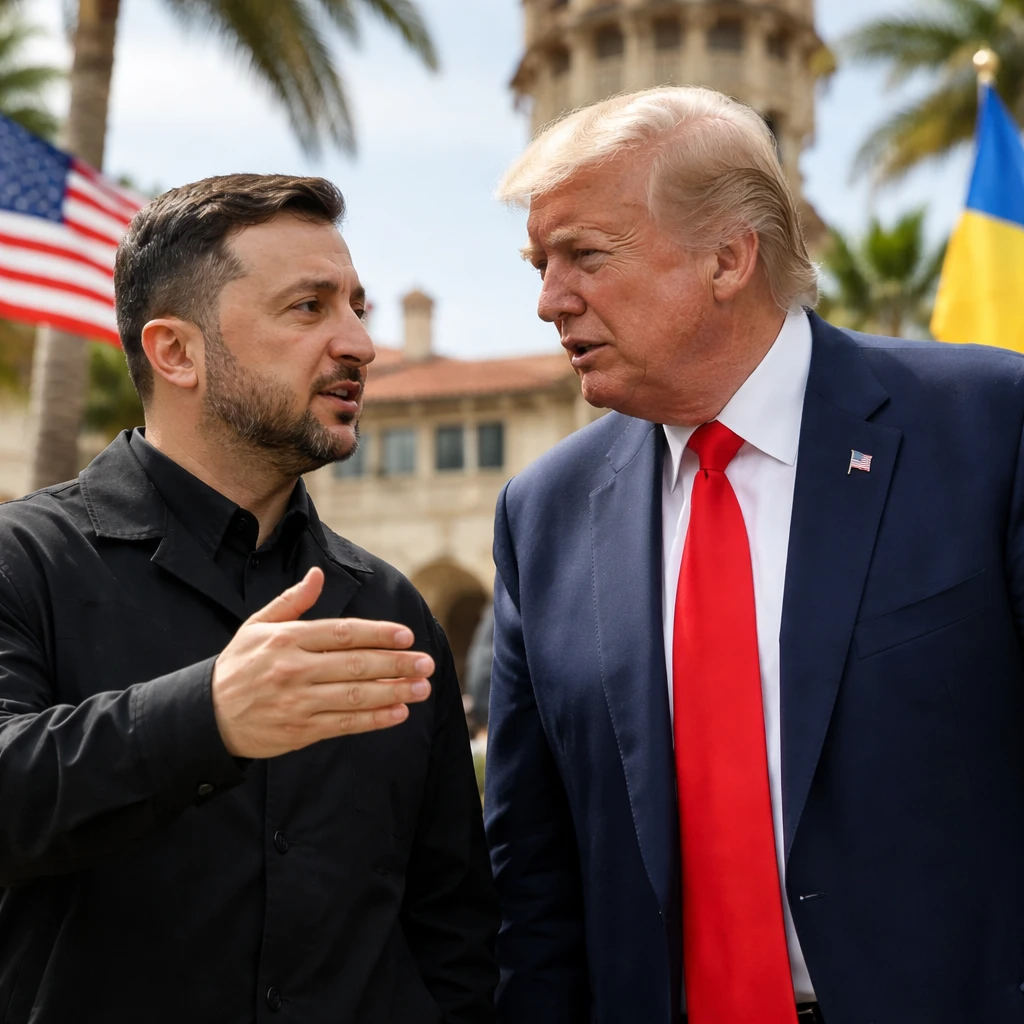
In Palm Beach, Florida, at his private club Mar-a-Lago, former U.S. President Donald Trump is set to meet Ukrainian President Volodymyr Zelenskyy on Sunday for talks focused on finalizing a peace agreement aimed at ending almost four years of conflict initiated by Russia’s invasion of Ukraine. Trump, spending the holiday season at Mar-a-Lago mainly engaged in golf, will engage with Zelenskyy primarily on matters of security partnerships and economic cooperation. Zelenskyy intends to address territorial disputes, particularly those concerning the contested Donbas region in eastern Ukraine, where the standoff between Moscow and Kyiv remains unresolved.
Russian forces have recently intensified their military pressure on Ukraine's capital, Kyiv, launching missile and drone strikes. This escalation seems aimed at exerting additional diplomatic leverage prior to the upcoming negotiations. In response, Zelenskyy communicated on the social platform X that Ukraine is prepared to undertake any necessary steps to halt the conflict, stressing the importance of maintaining strength during negotiation sessions.
Zelenskyy further stated that Ukraine desires peace; however, Russia appears inclined to perpetuate hostilities. He expressed confidence in global support from Europe and the United States to collectively prevent Russian advances. These remarks come amid sustained military pressures on Ukraine’s sovereignty.
During a meeting with Canadian Prime Minister Mark Carney in Halifax, Nova Scotia, Zelenskyy highlighted that imposing pressure on Russia, coupled with robust and sufficient aid to Ukraine, remains essential to achieve peace. Correspondingly, Canadian officials announced an additional $2.5 billion Canadian (approximately $1.8 billion U.S.) in economic assistance to facilitate Ukraine’s reconstruction efforts.
Carney condemned the "barbarism" of Russia’s recent attacks on Kyiv, commending both Zelenskyy and Trump for establishing conducive conditions for a just and lasting peace during a critical juncture. Trump's and Zelenskyy's face-to-face encounter underscores progress made through intensive negotiations, as teams from both sides have exchanged and revised draft agreements seeking to terminate the fighting.
According to Zelenskyy, the current peace proposal under consideration comprises approximately 20 points and is about 90% complete. This assessment aligns with optimism expressed by U.S. officials following recent discussions in Berlin involving Trump’s chief negotiators and the Ukrainian president.
The United States has reportedly agreed to furnish Ukraine with security guarantees analogous to some provisions extended to NATO allies. This gesture follows Zelenskyy’s indication that he would consider suspending Ukraine’s NATO membership aspirations if granted protective measures equivalent to NATO's, aiming to shield Ukraine from future Russian aggression.
In addition, Zelenskyy engaged in a Christmas Day conversation with U.S. special envoy Steve Witkoff and Jared Kushner, Trump's son-in-law, discussing specific substantive elements concerning ongoing negotiations. Zelenskyy cautioned that sensitive issues remain unresolved, indicating that the coming weeks will require intense diplomatic efforts.
Trump has invested considerable effort into facilitating an end to the Ukraine war throughout the first year of his administration, intermittently expressing frustration with both Zelenskyy and Russian President Vladimir Putin, while acknowledging the complexity involved in resolving the conflict. The expectation of a swift resolution, previously suggested by Trump during his 2024 presidential campaign, has since been moderated by the realities of the situation.
Following Zelenskyy’s October visit to the White House, Trump called for a ceasefire by both Russia and Ukraine to halt fighting along current front lines, implicitly conceding Russia’s territorial acquisitions. Prior to their meeting at Mar-a-Lago, Zelenskyy identified unresolved issues with the U.S. including territorial integrity, conditions around the Zaporizhzhia nuclear power station, and financial support for Ukraine’s reconstruction initiatives. Additional technical concerns involve security assurances and monitoring protocols.
Zelenskyy reported that Ukraine has communicated its positions to U.S. officials, anticipating that they will convey these to Russia. He expressed willingness to withdraw Ukrainian military presence from the eastern industrial hub as part of a peace agreement, conditional upon reciprocal Russian withdrawal and establishment of a demilitarized zone overseen by international peacekeepers.
Kremlin spokesperson Dmitry Peskov confirmed on Friday that dialogue channels between the Kremlin and the United States remain open and that further communication is planned.
Russian President Vladimir Putin has publicly asserted a demand for recognition of all territories seized by Russian forces in four key regions of Ukraine, including the annexed Crimean Peninsula since 2014, and has called for Ukraine to relinquish control over other eastern territories not currently under Russian occupation. Kyiv has openly rejected these demands. The Kremlin also insists Ukraine abandon NATO membership efforts and has warned against deployment of NATO troops on Ukrainian soil, which would be considered legitimate targets by Moscow.
Additionally, Putin has required Ukraine to cap its military size and grant official recognition to the Russian language, consistent demands throughout the conflict. Putin’s foreign affairs advisor, Yuri Ushakov, stated that Russian security forces would remain in parts of Donetsk, a major city in the Donbas region, even if designated as demilitarized under potential agreements.
Ushakov also noted that negotiating compromises could be protracted, citing that initial U.S. proposals accommodating Russian requests had been complicated by modifications introduced by Ukraine and its European allies.
Trump has shown partial agreement with some of Putin's conditions, arguing that Russia might cease hostilities if Ukraine cedes territory in the Donbas and if Western nations provide economic incentives to reintegrate Russia into the global economy.
Reporting contributions included inputs from Washington, London, Kyiv, and Toronto.