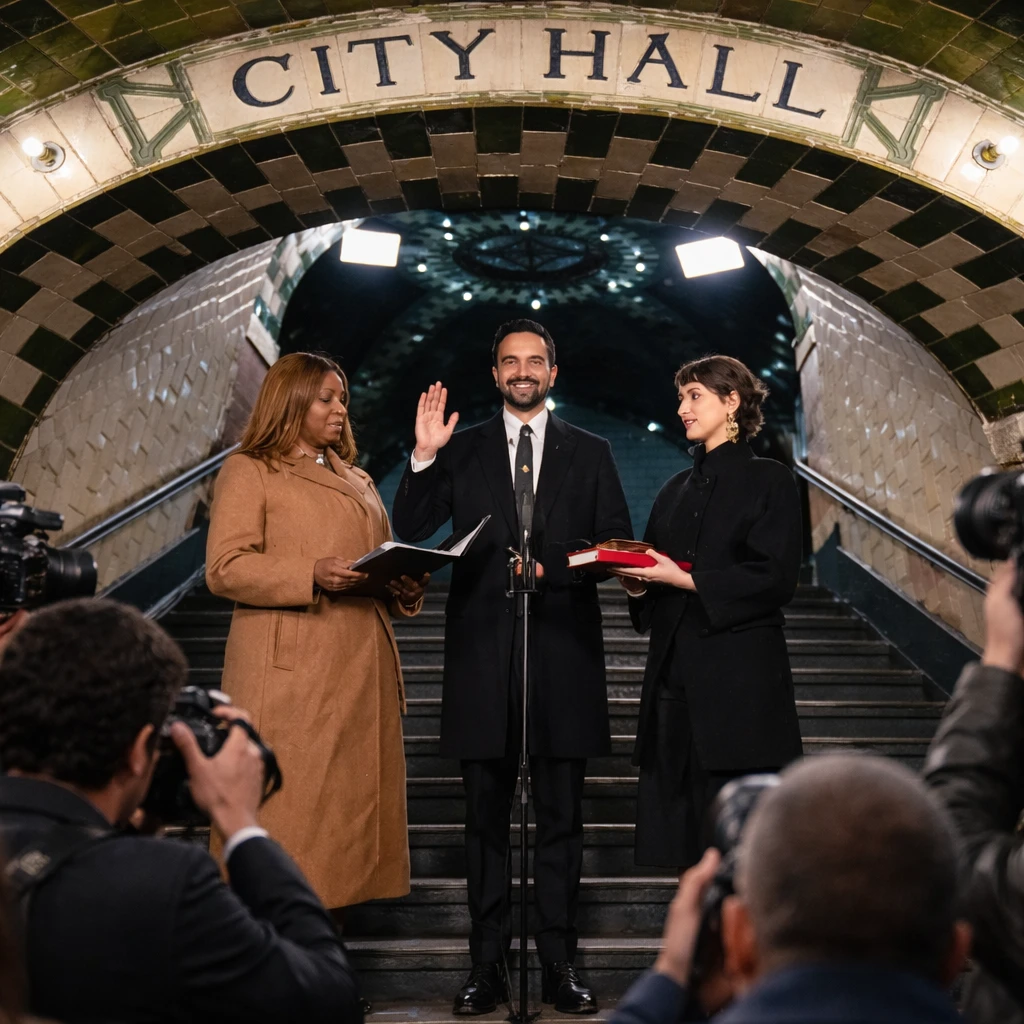

Zohran Mamdani took the oath of office as mayor of New York City just after midnight on Thursday, formalizing his entrance into one of the nation’s most demanding political roles. The ceremony was uniquely held in the iconic, now-closed City Hall subway station, a historic location in Manhattan known for its vaulted ceilings and early place in the city’s transit history. Mamdani, a Democrat, marked another first by becoming the city’s first Muslim mayor, placing his hand on a Quran during the swearing-in.
“This truly is a once-in-a-lifetime honor and privilege,” said Mamdani in a brief address following the private event officiated by New York Attorney General Letitia James, a political ally. Highlighting the venue, he emphasized how the station symbolizes the critical role public transportation plays in the vitality, health, and legacy of New York City. In this opening statement, he also announced the appointment of Mike Flynn as head of the Department of Transportation.
The inauguration was intimate, and Mamdani ended his comments with a smile, thanking attendees before ascending the stairs. Later in the day at 1 p.m., a more public and ceremonious swearing-in will be held at City Hall. That event is to be presided over by U.S. Senator Bernie Sanders, a prominent political figure and mentor to Mamdani. Following the ceremony, the city administration plans a public celebration along the Broadway corridor known as the “Canyon of Heroes,” famed for its confetti-filled parades.
Mamdani, at 34 years old, now undertakes what is widely recognized as one of the most grueling jobs in American politics, taking the helm as one of the country’s most closely watched leaders. His election breaks barriers beyond religion: he is the first mayor with South Asian heritage and the first African-born leader of New York City. Additionally, he holds the distinction of being the city’s youngest mayor in decades.
Throughout his campaign, Mamdani popularized “affordability” as a defining issue, pledging transformative reforms aimed at making life more economically accessible in one of the world’s priciest urban centers. His platform outlined an ambitious agenda including universal full-day kindergarten, fare-free bus service, rent freezes affecting approximately one million households, and a pilot initiative for municipally run grocery stores. Yet, despite these forward-looking policies, the mayor also inherits routine operational challenges such as trash management, snow removal, rodent control, public transit delays, and road maintenance.
Born in Kampala, Uganda, to filmmaker Mira Nair and academic/writer Mahmood Mamdani, Zohran’s family relocated to New York City when he was seven. Growing up in the post-9/11 environment presented its own challenges for Muslim communities. He acquired U.S. citizenship in 2018. Mamdani's political groundwork began in grassroots campaigns supporting Democratic candidates before he sought office himself, securing a seat in the state Assembly in 2020 representing part of Queens.
Now, Mamdani and his wife, Rama Duwaji, will move from their rent-stabilized one-bedroom apartment in a peripheral neighborhood to the mayor’s grand official residence in Manhattan, marking a significant personal transition alongside his professional advancement.
The city he inherits shows signs of resurgence following the slow recovery from the COVID-19 pandemic. Violent crime rates have dropped to levels comparable with pre-pandemic years, tourism has notably returned, and unemployment has reverted to prior low percentages after a spike in early 2020. Despite these positive indicators, economic concerns persist, particularly related to soaring living costs and rising rents.
Political dynamics with national figures promise complexity; during his mayoral campaign, former President Donald Trump threatened to withhold federal funding and suggested deploying the National Guard in New York should Mamdani win. However, in an unexpected gesture, Trump later invited Mamdani to the White House for a cordial meeting. Still, underlying profound policy disagreements, including on immigration, suggest ongoing tensions.
Mamdani faces additional scrutiny from elements within the city’s Jewish community due to his critical views of the Israeli government. Ahead of formally assuming office, the new mayor has assembled a team blending experienced insiders and newcomers to ensure operational continuity and policy execution. Notably, he has convinced Police Commissioner Jessica Tisch to remain in her role, which has helped soothe business and community fears about radical shifts in policing strategies under his administration.