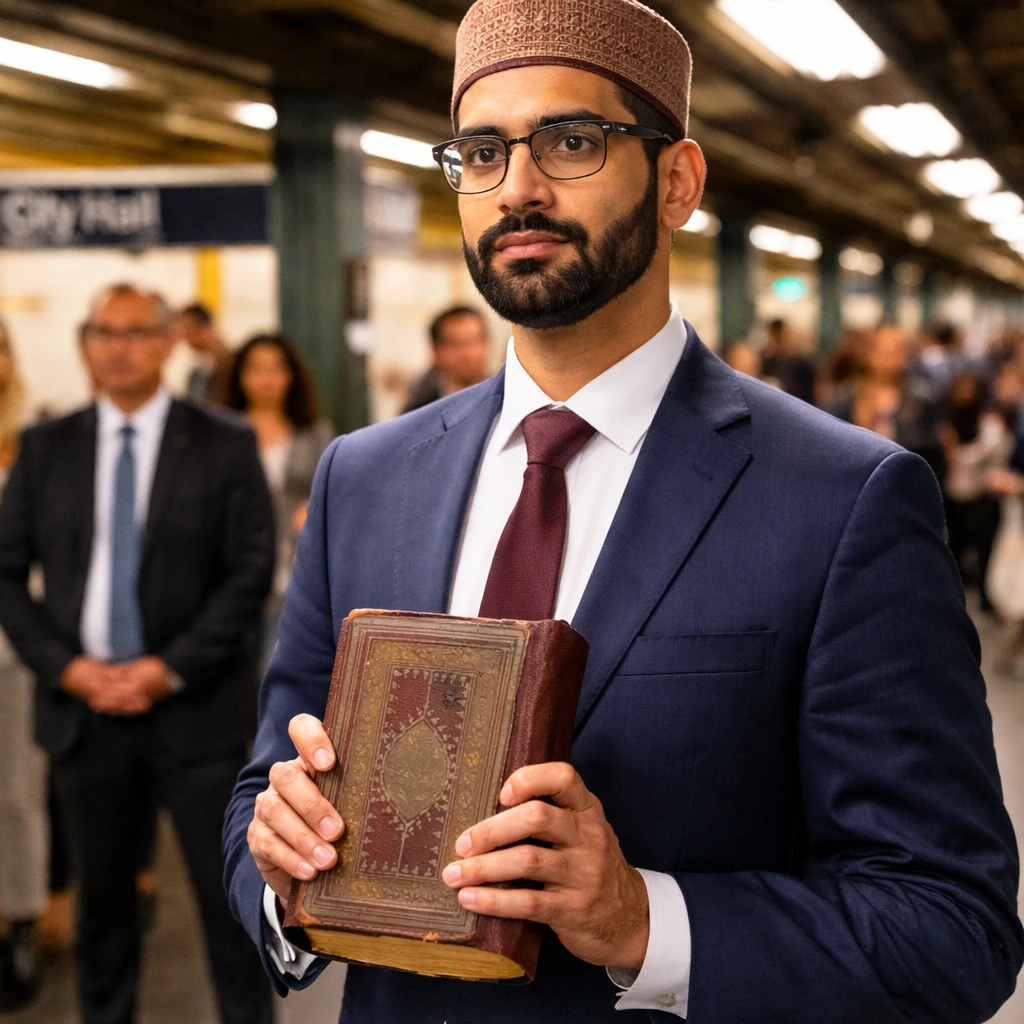

Zohran Mamdani is set to become New York City's mayor at midnight, taking the oath of office with his hand placed on an ancient Quran, an unprecedented move for the city. This marks the first occasion in New York City's history that the Quran, central to Islam, will be used during the mayoral swearing-in.
The 34-year-old Democratic mayor-elect will take his oath in a long-disused subway station situated directly beneath City Hall. His ascendancy figures several significant firsts for the city: he is the first Muslim, the first person of South Asian descent, and the first individual born in Africa to serve as its mayor. These milestones highlight the diversity entrenched within New York City, one of the most populous and culturally varied cities in the United States.
A historian specializing in Middle Eastern and Islamic studies assisted Mamdani's wife, Rama Duwaji, in selecting the Quran to be used. This sacred book verses back centuries, symbolizing both the faith and the longstanding presence of Muslim inhabitants in the metropolis.
While the oath mandates allegiance to the constitutions of the United States, the state of New York, and the city itself, it does not legally require the use of a religious text. Traditionally, most of Mamdani’s predecessors opted to swear on a Bible.
Throughout his campaign, Mamdani prioritized affordability but was also vocal about his Islamic faith. Visiting numerous mosques across the city's five boroughs, he galvanized support from many first-time Muslim and South Asian voters.
A Trio of Qurans for the Ceremony
At the subway station event, Mamdani will place his hand on two Qurans: one previously owned by his grandfather and another pocket-sized copy estimated to date from the late 1700s to early 1800s. This smaller Quran is part of the New York Public Library's Schomburg Center for Research in Black Culture's collection.
According to Hiba Abid, the curator for Middle Eastern and Islamic Studies at the Schomburg Center, this particular Quran symbolizes the city’s Muslim diversity and religious heritage. Although small in size, it encapsulates connections between faith and New York City's historical identity.
For a separate swearing-in ceremony scheduled for New Year's Day at City Hall, Mamdani plans to use both his grandfather’s and grandmother’s Qurans. The campaign has not disclosed further information about these family heirlooms.
The Historical Journey of the Quran
This manuscript originally belonged to Arturo Schomburg, a Black Puerto Rican historian known for collecting artifacts relating to the global black diaspora. While the exact path by which Schomburg acquired the Quran is unknown, scholars surmise it reflects his interest in the link between Islam and black cultures in America and Africa.
Contrasting with ornate religious copies associated with nobility or formal use, this Quran has a modest aesthetic. Bound in deep red with a simple floral medallion, its pages display script in black and red ink that is clear and straightforward, indicating it was likely intended for everyday readers rather than ceremonial purposes.
Because the manuscript lacks a date or signature, experts estimated its origin based on the style of binding and script. They suggest it was produced during the Ottoman era in a region encompassing present-day Syria, Lebanon, Israel, the Palestinian territories, and Jordan.
Abid posits the Quran’s trajectory to New York parallels Mamdani’s diverse heritage. Mamdani himself is a South Asian native of Uganda, while his wife, Rama Duwaji, is of American-Syrian descent.
Identity and Political Challenges
Mamdani’s swift rise as a Muslim democratic socialist candidate invited a surge in Islamophobic criticism, amplified amid intense media focus on his candidacy.
In an emotionally charged speech before the election, he stated that such animosity only fortified his commitment to openly embrace his faith. He declared, "I will not change who I am, how I eat, or the faith that I’m proud to call my own. I will no longer look for myself in the shadows. I will find myself in the light."
Using the Quran for the oath has drawn some conservative backlash. Notably, U.S. Senator Tommy Tuberville from Alabama responded on social media with the phrase, "The enemy is inside the gates," commenting on Mamdani's inauguration plans. Civil rights organization the Council on American-Islamic Relations has previously labeled Tuberville an anti-Muslim extremist based on his history of statements.
Such responses have precedence. In 2006, Keith Ellison, the first Muslim elected to the U.S. Congress, faced conservative disapproval for his choice to use the Quran during his swearing-in.
After the Inauguration
Following the ceremonies, the Quran used in the subway event will be displayed publicly at the New York Public Library. Curator Hiba Abid hopes that the attention generated—both welcoming and critical—will encourage more visitors to engage with the library’s archives illustrating Islamic life in New York City. These collections include early 20th-century Armenian and Arabic music recorded locally and personal narratives documenting Islamophobia post the September 11 attacks.
“The manuscript was meant to be used by ordinary readers when it was produced,” Abid reflected. “Today it lives in a public library where anyone can encounter it.”
Contributors to this coverage include Jake Offenhartz in New York and Kim Chandler in Montgomery, Alabama.