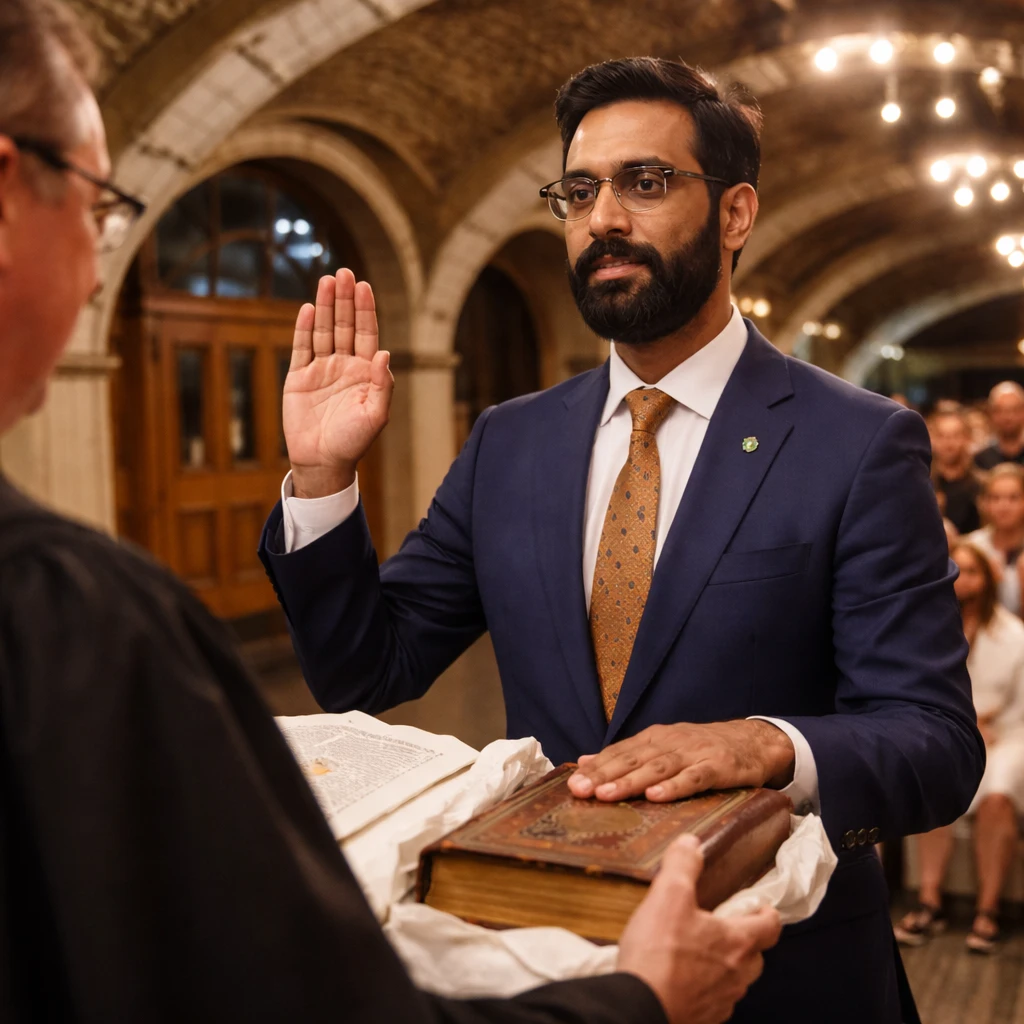
In a landmark event, Zohran Mamdani was sworn in as mayor of New York City, utilizing a centuries-old Quran during his oath ceremony held at midnight. This marks the first instance in which the city’s mayor has taken the oath on Islam’s holy text, reflecting a historic milestone for the city’s governance. At 34 years of age, Mamdani distinguished himself not only through his unique choice of religious text but also by being the inaugural Muslim, South Asian, and African-born individual to serve as New York City’s chief executive.
The oath-taking occurred in a previously closed subway station located beneath City Hall, further symbolizing the unconventional and historic nature of this transition. The utilization of the Quran during the oath reflects the longstanding and dynamic Muslim population that constitutes part of the city’s diverse social fabric. This selection was supported by a scholar assisting Mamdani’s spouse, Rama Duwaji, in choosing one of the holy texts for the ceremony.
Historically, preceding mayors have commonly sworn their oaths on a Bible, though such practices are not mandated by law. The mayoral oath requires affirmation to uphold the constitutions of the United States, the State of New York, and New York City, but it does not prescribe the use of any religious scripture.
Mamdani's campaign was marked by a significant emphasis on affordability across the city. Alongside his policy focus, he openly embraced his Muslim faith, regularly appearing at mosques throughout the five boroughs. His visible religious identity strengthened his rapport with constituents, particularly among South Asian and Muslim first-time voters.
A Trio of Qurans and Their Symbolism
During the subway station inauguration, two Qurans were utilized: one belonging to Mamdani’s grandfather and another pocket-sized edition estimated to date from the late 18th or early 19th century. The latter is part of the New York Public Library’s Schomburg Center for Research in Black Culture collection. Hiba Abid, the center’s curator for Middle Eastern and Islamic Studies, noted that this Quran epitomizes the diversity and breadth of the Muslim community within New York City’s historical narrative. She remarked, "Despite its small size, it embodies elements of faith and identity integral to New York City."
For a subsequent ceremony at City Hall on January 1, Mamdani plans to use Qurans owned by both his grandfather and grandmother. Specific details concerning these heirlooms have not been disclosed by the campaign.
The Historical Journey of the Quran
The particular Quran used in the ceremony once belonged to Arturo Schomburg, an esteemed Black Puerto Rican historian known for chronicling the global contributions of people of African descent. While the exact circumstances by which Schomburg acquired the manuscript remain unclear, scholars surmise it was aligned with his scholarly interest in the intertwined histories of Islam and Black communities in the United States and Africa. The Quran differs from more ornate religious manuscripts associated with elites or royalty; it features a modest deep red binding with a plain floral medallion, inscribed in black and red ink with accessible script intended for daily use rather than ceremonial exhibition.
These attributes underscore the manuscript’s primary purpose for everyday readers, underscoring the significance of accessibility over luxury in its use. Dating of the manuscript, inferred through its binding and script style, places its origin within the late 18th or early 19th century during the Ottoman Empire, in regions corresponding to modern-day Syria, Lebanon, Israel, the Palestinian territories, and Jordan.
Abid highlighted that the Quran’s provenance reflects a layered identity similar to that of Mamdani himself, who is a South Asian New Yorker born in Uganda. His wife, Duwaji, is of American-Syrian descent, illustrating a multifaceted cultural heritage embedded in the ceremony.
Faith and Public Scrutiny
Mamdani’s swift political ascent has been accompanied by a wave of Islamophobic rhetoric, heightened by the national spotlight his race and faith have attracted. In a heartfelt address shortly before the election, he emphasized that such challenges only fortified his determination to be open about his religious identity, stating, "I will not change who I am, how I eat, or the faith that I’m proud to call my own. I will no longer look for myself in the shadows. I will find myself in the light."
The choice to swear in on a Quran has triggered criticism from certain conservative quarters. For instance, U.S. Senator Tommy Tuberville of Alabama reacted on social media with the phrase, "The enemy is inside the gates," in reference to coverage of Mamdani’s inauguration. The Council on American-Islamic Relations has categorized Tuberville as an anti-Muslim extremist due to his prior remarks. Such opposition echoes past controversies, reminiscent of the backlash faced in 2006 by Keith Ellison, the first Muslim elected to the U.S. Congress, who similarly used a Quran for his ceremonial oath.
Legacy and Public Access
Following the inauguration, the Quran utilized in the ceremony will be exhibited at the New York Public Library. Curator Hiba Abid expressed hope that the attention surrounding Mamdani’s oath—whether positive or negative—would encourage a broader public engagement with the library’s collections documenting Islamic life in New York City. These holdings range from early 20th century Arabic and Armenian music recorded in the city to firsthand narratives detailing experiences of Islamophobia after September 11.
Abid remarked, "Originally, this manuscript was created for use by ordinary readers. Now, it resides in a public library where anyone can encounter it."
Contributing writers to this report included Jake Offenhartz from New York and Kim Chandler from Montgomery, Alabama.