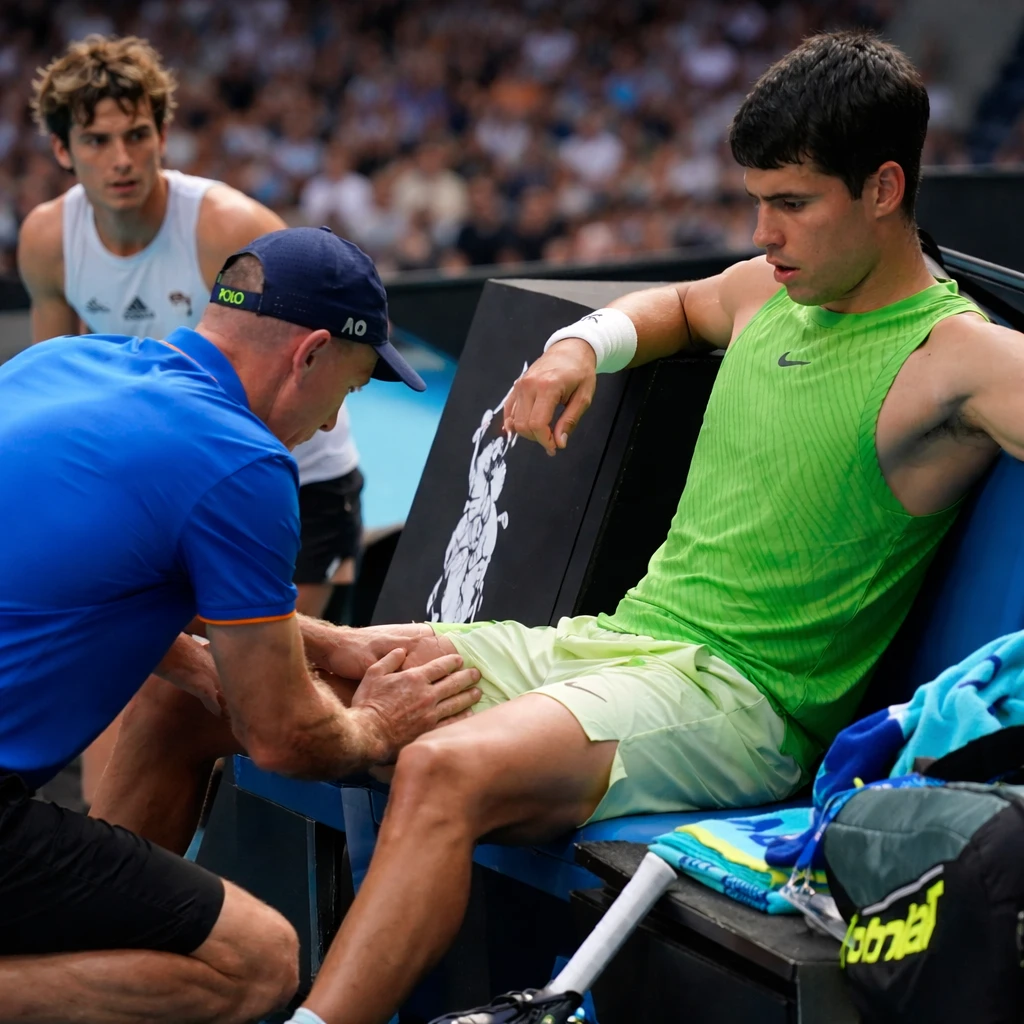

Alexander Zverev expressed visible frustration on the court after Carlos Alcaraz was granted a medical timeout in the third set of their Australian Open semifinal. This match stretched close to five and a half hours, marked as the longest semifinal in the tournament's history. Speaking after the match, Zverev reiterated his initial view shared earlier with a tournament official, stating he believed Alcaraz was suffering from cramps, a condition he felt did not warrant a medical timeout.
"Normally, cramping does not justify a medical timeout," Zverev said. "It's not my decision, but I didn’t agree with it." His comments came shortly after he lost an arduous five-set battle.
Carlos Alcaraz appeared for his official press conference approximately two hours later, providing a different account. He explained that the pain prompting the timeout was very focused on a single muscle. Such a situation qualifies under tournament rules for a medical timeout.
Alcaraz, aged 22, shared that although he had experienced cramps before, this time it felt different. The discomfort was localized and confined to one muscle, which led him to initially doubt it was a typical cramp. The match began in typical Melbourne summer temperatures of around 30 degrees Celsius, cooling slightly to about 27 degrees Celsius when the injury impacted Alcaraz nearly two hours and 40 minutes into play.
"I wasn’t certain what it was at first," Alcaraz explained, "but then I felt a specific pain in my right adductor. That moment I called the physio because of the sudden discomfort." His left leg was reportedly unaffected at the time.
The incident occurred in the ninth game of the third set, with Alcaraz holding a two-set advantage. He began limping and appeared to struggle with an upper right leg issue. After holding his serve to lead 5-4, Alcaraz requested a medical timeout during the changeover, during which he massaged the inside of his right thigh and consulted with the trainer for treatment.
"Under the stress and uncertainty about my condition and whether it might worsen, I reached out to the physio," Alcaraz detailed. "It was their decision to take the medical timeout." Despite restricted movement, Alcaraz managed to win points and reached 6-5 before receiving further physiotherapy during the subsequent changeover.
The crowd responded enthusiastically upon his return, cheering him on as he worked back into the match. Zverev faltered with a double fault to start the next game, while Alcaraz produced a lob and a forehand winner to secure a 0-30 lead, just two points from victory. Nevertheless, Zverev fought back, winning four consecutive points to force a tiebreaker, which he ultimately won.
Following the tiebreaker, Zverev secured victory in the next two sets but acknowledged missed opportunities to conclude the match sooner, which would have conserved energy for a decisive fifth set.
"It was an unbelievable battle," Zverev reflected. "Although I lost, I gave everything. My legs just gave out; I couldn't rely on my serve as I normally do. Such is life in competitive sports—one must move forward."
The matter of timing regarding medical timeouts has sparked public debate, particularly after the tournament's extreme heat policy was enacted during an earlier match involving Jannik Sinner, who also experienced cramps. Sinner, after a break to close the roof, returned revitalized and overcame his fatigue to advance.
Widespread discussion arose online surrounding Alcaraz's medical timeout as well, though Zverev indicated a preference to move past the topic.
"This was one of the greatest matches held in Australia," he remarked. "It doesn't deserve to be overshadowed by controversy now."