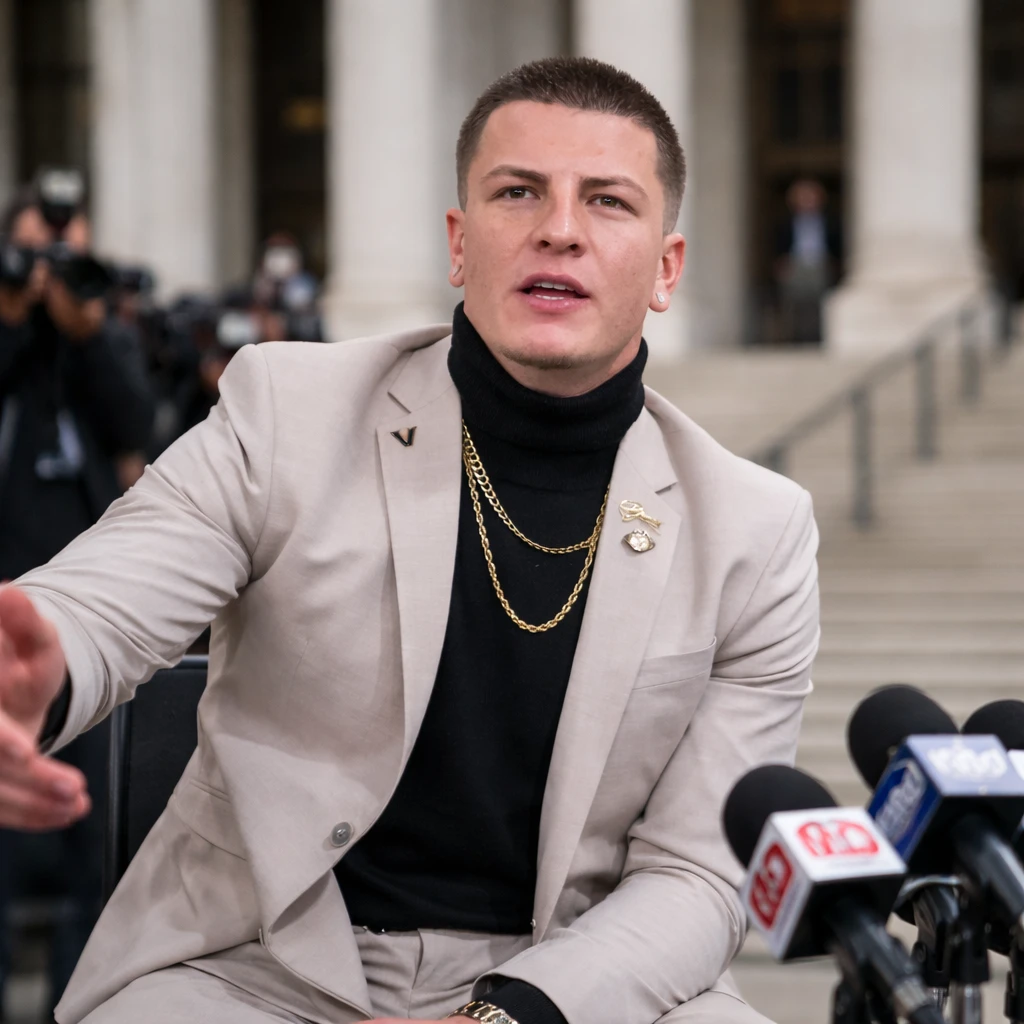
Diego Pavia’s Legal Challenge Against NCAA Gains Momentum Following NBA Draft Pick's College Return
December 26, 2025
News & Politics

Diego Pavia’s Legal Challenge Against NCAA Gains Momentum Following NBA Draft Pick's College Return

Federal court hearing highlights NCAA's eligibility rules amidst contrasting athlete cases

Summary

Diego Pavia, a former junior college football player and Heisman Trophy runner-up, continues his legal action against the NCAA's eligibility criteria, citing the recent return of NBA draft pick James Nnaji to college basketball as support. The case contends with the NCAA's rigid rule that counts junior college seasons against Division I eligibility, an issue attracting multiple plaintiffs and considerable scrutiny as courts evaluate fairness in college sports regulations.

Key Points

Diego Pavia and 26 football players are suing the NCAA to challenge its eligibility rules for former junior college players.
The lawsuit highlights the NCAA’s contrasting treatment of basketball player James Nnaji, who returned to college sports after four years of professional play and being an NBA draft pick.
Nnaji’s case has been used as evidence of NCAA inconsistency in eligibility enforcement, particularly concerning professional experience and age.
Pavia was granted a preliminary injunction in his case and led Vanderbilt to a historic No. 13 AP ranking this season.
The NCAA rules allow five years to play four seasons and count any collegiate institution enrollment toward eligibility, which affects players with junior college experience like Pavia.
The lawsuit has extended to include additional plaintiffs, such as Tennessee quarterback Joey Aguilar.
Downton also handles another lawsuit focused on the NCAA’s redshirt laws, with Vanderbilt linebacker Langston Patterson as a leading plaintiff.
The ongoing litigation reflects significant legal pressure on NCAA policies governing athlete participation.

In Nashville, Tennessee, attorney Ryan Downton, representing Heisman Trophy runner-up Diego Pavia and 26 other collegiate football players, has leveraged the NCAA's recent decision allowing NBA draft pick James Nnaji to resume college basketball to argue for his clients’ eligibility to compete in the 2026 and 2027 seasons.

Although Diego Pavia intends to declare for the NFL draft, he persists with a legal challenge against the NCAA. His lawsuit disputes a regulation that treats seasons played at junior college as counting toward the permissible participation timeline in Division I football.

On Christmas Eve, Baylor University proclaimed the addition of 7-foot center James Nnaji to their basketball roster. Nnaji brings the experience of four professional seasons in Europe and was selected 31st overall in the NBA draft by the Detroit Pistons; his rights have since been transferred to both the Charlotte Hornets and the New York Knicks.

Downton highlighted Nnaji’s case in a memorandum filed on Friday with U.S. District Judge William L. Campbell. He calls for an injunction preventing the NCAA from enforcing eligibility rules he deems inconsistent, especially given Nnaji’s exemption despite a professional background.

Opening his memorandum by referencing Clement Clarke Moore’s classic poem, Downton dramatically underscored what he identifies as NCAA hypocrisy: allowing a 21-year-old with four years of professional play and a prior NBA draft selection to maintain four years of college eligibility.

The memorandum points out that Nnaji, who also participated in the NBA Summer League, will still retain eligibility at age 25. Meanwhile, the NCAA defends its position by asserting that extending eligibility to older former junior college players disadvantages high school seniors.

Pavia’s initial lawsuit against the NCAA began in November 2024, leading to a preliminary injunction that granted him eligibility for the current season. Under his leadership, Vanderbilt achieved a No. 13 ranking in the AP poll, marking a historically successful season and securing a spot against Iowa in the upcoming ReliaQuest Bowl on December 31.

The lawsuit now includes 26 additional plaintiffs, such as Tennessee quarterback Joey Aguilar, who collectively aim to contest the NCAA’s stringent eligibility timeline. Under NCAA rules, athletes have five years to participate in four seasons, with the clock starting upon enrollment at any collegiate institution, regardless of NCAA membership.

For Pavia, his collegiate timeline began in 2020 at the New Mexico Military Institute. That year was not sanctioned against his eligibility due to COVID-19 exceptions. After securing the junior college national title in 2021, he played for New Mexico State in 2022 and 2023 before transferring to Vanderbilt for 2024. This schedule has resulted in his sixth collegiate season overall but only his fourth at the Division I level.

The NCAA faces multiple legal challenges concerning its eligibility policies. Downton also represents players in a separate lawsuit on the NCAA’s redshirt rule, featuring Vanderbilt linebacker Langston Patterson and others petitioning Judge Campbell on December 15 for an injunction allowing participation in the 2026 season.

Risks
  • Potential changes in NCAA eligibility rules depending on court outcomes could disrupt collegiate athletic programs.
  • Legal uncertainty around eligibility may affect athlete recruiting, retention, and team composition in college sports, particularly football and basketball.
  • Athletes with junior college or professional experience face unclear pathways to college competition, adding risk to their career planning.
  • Universities and the NCAA may confront financial and reputational risks if rules are found to be discriminatory or inconsistently applied.
  • Sports markets could experience shifts due to altered team rosters and player availability resulting from eligibility disputes.
  • Legal developments may influence policy frameworks governing collegiate athletics nationwide, affecting sports governance.
  • Player development pathways might be impacted by fluctuating eligibility standards and legal precedents.
  • Litigation outcomes could set precedents affecting collegiate sports economics and compliance strategies.
Disclosure
The article is based entirely on facts reported in the cited news content. No additional information, speculation, or external references were introduced beyond the provided text. All legal assertions and athlete details pertain to the documented court filings and NCAA announcements.
Search Articles
Category
News & Politics

News & Politics

Related Articles
American Express Expands NBA Partnership, Driving Stock Momentum

American Express (NYSE:AXP) shares advanced as the company renewed and broadened its partnership wit...

FDA Initiates Review of BHA Food Additive Safety

The U.S. Food and Drug Administration (FDA) has announced plans to conduct a comprehensive reassessm...

Partisan Divide Deepens as White House Excludes Democratic Governors from NGA Meeting

The longstanding bipartisan forum of the National Governors Association (NGA) is facing disruption a...

Using Fireplace Ashes in Your Garden: Benefits and Considerations

Amidst a notably cold winter leading to increased fireplace use, many homeowners are seeking sustain...