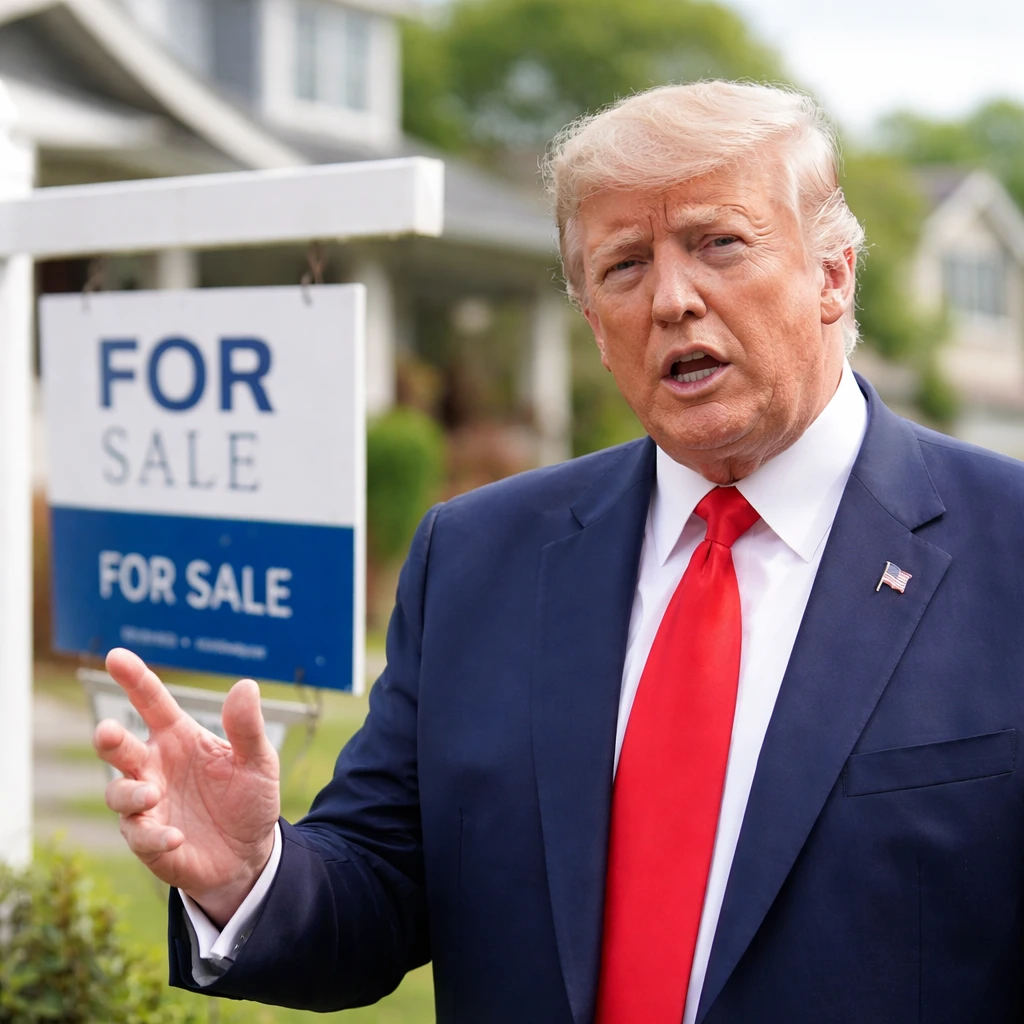

During his address at the World Economic Forum in Davos, Switzerland, former President Donald Trump detailed a quartet of policy priorities directed at enhancing the affordability of homeownership across the United States. These initiatives, each previously flagged in recent weeks by Trump or his administration, form part of a broader strategy to counteract the entrenched housing affordability issues influencing voter sentiment ahead of the midterm elections.
The U.S. housing market continues to experience a marked slowdown that began in 2022, coinciding with a rise in mortgage interest rates from the historically low levels established during the pandemic. This rate increase, coupled with a decade-plus stretch of subdued home construction and soaring property prices, has positioned homeownership beyond the financial reach for many hopeful buyers. Reflecting these pressures, sales of existing homes nationwide remained near three-decade lows last year.
Trump emphasized the importance of reducing borrowing costs on both home mortgages and credit cards to bolster buyers' financial capacity, facilitating accumulation of down payments and enhancing overall purchasing power.
"We can lower interest rates to a level that benefits everyone," Trump asserted. "This natural adjustment is something we definitely want to pursue, as paying lower interest rates is advantageous across the board."
He noted a directive he issued for the federal government to acquire $200 billion in mortgage bonds, a plan intended to bring down mortgage rates. Trump mentioned earlier that housing agencies Fannie Mae and Freddie Mac hold $200 billion in cash reserves available for purchasing such bonds. Nevertheless, economists have expressed skepticism, suggesting that this measure may only produce a marginal effect on actual mortgage rates.
Alongside advocating for lower rates, Trump reiterated his intention to announce a successor for Federal Reserve Chair Jerome Powell, whose term concludes in May, conveying confidence in the prospective appointee’s capabilities. Persisting in his past year's campaign to press the Federal Reserve toward rate cuts, Trump expressed hope that a new chair would continue efforts to ease borrowing costs.
However, history illustrates that reductions in the federal funds rate do not consistently translate to falling mortgage rates; in late 2024, despite the first Fed rate reduction in over four years, mortgage interest climbed, surpassing 7% by January, coinciding with an uptick in the 10-year Treasury yield toward 5%. More recently, data from Freddie Mac indicates the average 30-year mortgage rate stood at 6.06%, the lowest in over three years.
Despite these financing improvements, the most significant obstacle for prospective homeowners remains saving sufficiently for a down payment. Addressing this, Trump announced a legislative proposal requesting Congress to enforce a temporary cap on credit card interest rates at 10% for one year, responding to the industry's failure to voluntarily comply with a prior demand to apply such a cap by January 20. Currently, credit card rates average approximately 21%, according to the Federal Reserve Bank of New York.
Another critical component of Trump’s plan involves restricting large institutional investors from purchasing single-family homes to reduce competition faced by everyday Americans in the housing market. "Homes are designed for people, not corporations," he asserted, emphasizing the goal of preserving homeownership and preventing mass rental markets.
While advocating increased affordability, Trump acknowledged the delicate balance necessary to protect existing homeowners who have accumulated considerable home equity. He warned that aggressively lowering housing costs could undermine home values, adversely affecting millions currently holding residential properties.
Details on which policy actions might tip this balance were not specified. On Tuesday, Trump issued an executive order mandating a review of federal laws concerning institutional investor acquisitions of single-family houses. The order aims to identify anti-competitive behaviors, ensures that ordinary buyers have priority access to foreclosed properties before investors, and prevents government housing agencies from facilitating large-scale institutional purchases. Notably, the directive exempts companies that construct homes intended for rental markets.
The administration has not provided explicit criteria for defining 'large' investors. While certain metropolitan regions, including Atlanta and Phoenix, experience higher proportions of corporate-owned rental homes, most rental properties are held by individual small-scale investors, who would remain unaffected by the purchase restrictions.
Industry experts, such as Daryl Fairweather, chief economist at Redfin, have opined that the proposed policies are unlikely to meaningfully impact the housing market.
Though Trump intended to present further housing policy details during his speech, he devoted substantial portions to other topics. Kevin Hassett, head of Trump's National Economic Council, described the address as a prelude to upcoming announcements. Reports indicate additional policies under consideration include mechanisms enabling Americans to leverage 401(k) retirement savings for home down payments.