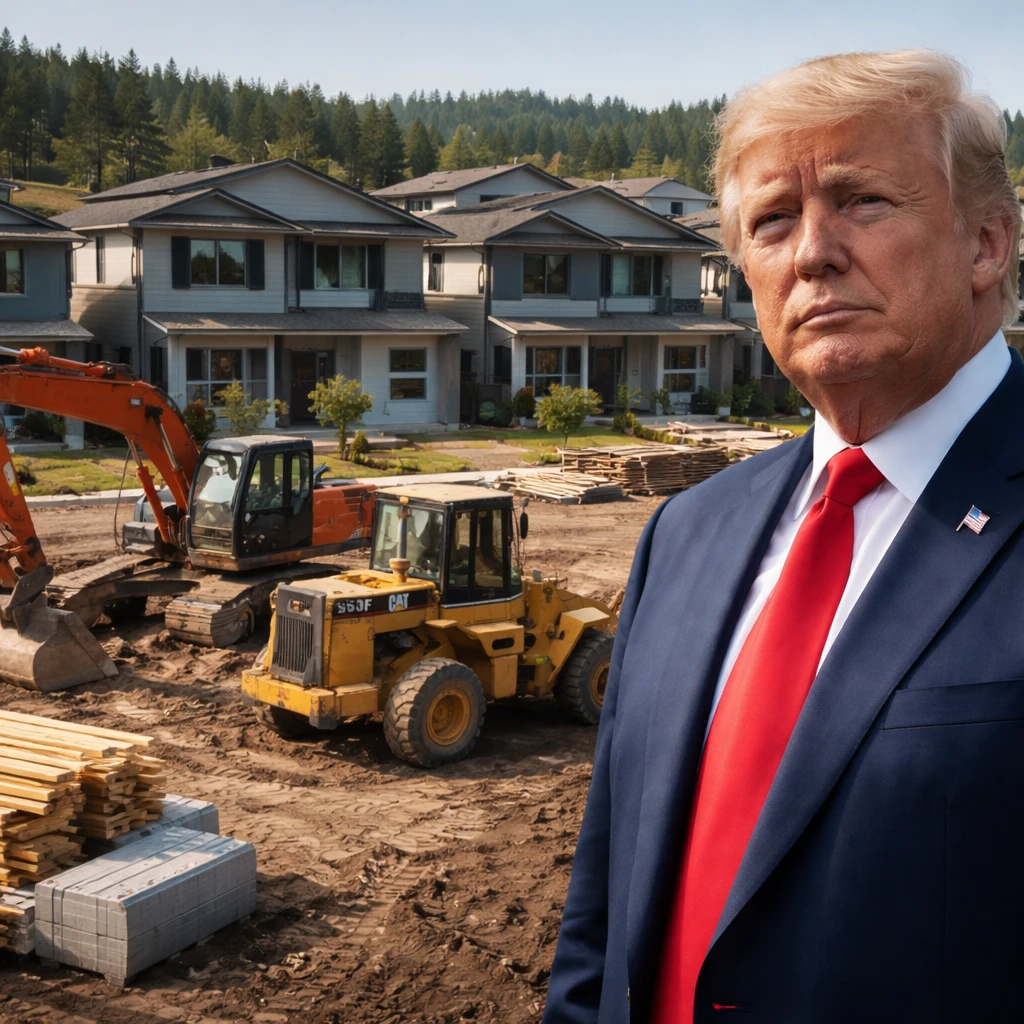

In the current political landscape, President Donald Trump has articulated a clear preference for policies aimed at sustaining high home prices, diverging from widespread calls to expand housing construction as a remedy for America's affordability crisis. Instead of championing increased building activity to ease market pressures, Trump has underscored the importance of safeguarding the property values of existing homeowners who have benefited from appreciable home price gains.
During a Cabinet meeting on January 29, he stated unequivocally, "I don’t want to drive housing prices down. I want to drive housing prices up for people that own their homes, and they can be assured that’s what’s going to happen." This viewpoint runs counter to proposals advanced by many economists, real estate stakeholders, municipal officials, and renters, who largely agree that boosting construction supply is critical to address affordability challenges.
Trump’s policy orientation appears aligned with his political calculus of appealing to older voters, notably baby boomers who tend to have higher voter turnout rates in midterm elections. As November’s elections will determine congressional control, this demographic's support is seen as pivotal. The president remarked, "You have a lot of people that have become wealthy in the last year because their house value has gone up. And you know, when you get the housing—when you make it too easy and too cheap to buy houses—those values come down."
Still, this approach may risk alienating younger voters, who were instrumental in expanding Trump’s coalition in 2024. Brent Buchanan of Cygnal polling warns of a potential "generational war" emerging in upcoming elections. He emphasized the critical role of the under-40 demographic, noting, "Their desire to show up in an election or not is going to make the difference in this election. If they feel that Donald Trump is taking care of the boomers at their expense, that is going to hurt Republicans."
Data from the 2024 presidential election reveals that 81% of Trump voters are homeowners, with many holding mortgages at favorable rates or owning outright. This pattern may reduce the immediacy of housing affordability as an issue for much of his base. However, economists like Oscar Pocasangre from New America highlight the trade-off in focusing on older voters, cautioning that expanding the overall electorate remains vital for electoral success.
Housing affordability remains a foremost concern among voters, especially younger ones, as reflected in polling ahead of 2026 elections. Individuals such as Booker Lightman, a 30-year-old software engineer from Colorado, describe housing shortages as a critical problem impacting their states. After recently purchasing a home, Lightman noted the insufficient housing supply is driving residents away. Real estate agents like Shay Hata, active across Chicago and Denver, report intense competition for limited inventory, with many properties attracting numerous bids.
Construction of new homes can facilitate affordability by providing buyers with options that often include lowered mortgage rates through builder-preferred lenders, Hata explains. Nevertheless, housing permit data contradicts this need. According to the U.S. Census Bureau, single-family home building permits have decreased by 9.4% over the past year, reaching an annualized rate of 876,000 by October, coinciding with Trump's incumbency.
While Trump's campaign rhetoric initially included proposals to stimulate housing supply through tax incentives, regulatory easing, and utilization of federal lands, recent actions reveal a heightened focus on monetary policy over construction. He has urged the Federal Reserve to reduce benchmark interest rates to lower mortgage costs and pushed for Fannie Mae and Freddie Mac to expand home loan securities purchases by $200 billion to achieve this goal.
Additionally, Trump advocates for legislation prohibiting large financial firms from purchasing homes, attempting to limit investor competition in the housing market. However, he has declined to support expansions allowing homebuyers to use retirement accounts for down payments, citing concerns over withdrawing funds from strong stock market investments.
Meanwhile, legislative efforts across party lines seek to promote housing development through zoning reform and other incentives, indicating recognition of the supply issue by lawmakers beyond the executive branch.
Underlying this policy debate is a persistent trend of home prices increasing at a pace outstripping income growth, complicating efforts for many to amass down payments or upgrade residences. For numerous families, their homes serve as both shelter and a substantial component of their financial portfolio, creating a paradox where nominal wealth does not equate to liquidity or affordability.
Furthermore, anticipated economic growth could amplify demand for homes, escalating prices and intensifying affordability pressures. Experts like Edward Pinto of the American Enterprise Institute note that substantial increases in single-family home construction—ranging from 50% to 100% over three years—would be required to stabilize average home prices, suggesting substantial supply-side interventions are necessary to alter current trends. Pinto asserts, "It's very hard to crater home prices," underscoring the complexity of housing market dynamics.